
Designing Buildings to Recover After Earthquakes
Sustainable Seismic Design for Controlled Damage Repair and Realignment
Based on the JCEMA article Analytical Cases of Sustainable Seismic Design
Fariborz M. Tehrani, Markar Grigorian and Fatemeh Gorji Sinaki

Conceptual visualisation of a recoverable structural system. The image does not represent a completed building or a tested prototype from the source paper.
Earthquake-resistant design has traditionally measured success through life safety and collapse prevention. Those objectives remain essential, but a building can remain standing and still be left with residual drift, damaged connections, impaired services and repair costs that make demolition the practical outcome.
The JCEMA paper Analytical Cases of Sustainable Seismic Design examines a broader objective. It connects seismic resilience with sustainability by asking how a structure can control where damage occurs, preserve stability, support realignment and permit repair after strong ground motion. The proposed framework is analytical and conceptual. It offers a direction for design rather than a universally validated building system.
When Standing Is Not the Same as Recovering
Modern seismic codes set minimum requirements intended to protect occupants and reduce the likelihood of collapse. They do not necessarily require a building to remain immediately usable after a severe earthquake. Structural yielding, residual deformation and damage to partitions, facades, services or gravity-load connections can make a nominally successful building difficult to repair.
Performance-based seismic design adds explicit performance objectives, but the article argues that functional recovery must also be reflected in the structural arrangement and construction details. A recovery objective cannot be added after the earthquake. The load path, damage locations, access for replacement and restoring mechanism must be planned before construction.
In this context, sustainable seismic design is not defined by using less material alone. It aims to extend the service life of the building and preserve the resources already invested in it. A repairable structure may avoid the environmental and economic consequences of demolition, debris removal, replacement materials and prolonged disruption.
What Sustainable Seismic Design Requires
The paper links sustainable seismic design with post-earthquake repair and realignment. Its proposed strategy separates the tasks that conventional framing often performs simultaneously. Gravity loads remain with the gravity system, earthquake energy is directed toward designated resisting systems, and restoring forces are supplied by a dedicated rocking core or related mechanism.
This separation makes the intended behaviour easier to inspect and manage. The gravity system should not develop unintended lateral resistance that damages its joints or obstructs recentering. Non-structural components should be detailed so that they neither absorb significant seismic energy nor prevent the structure from returning toward alignment.
| Structural component | Intended role in the proposed framework |
| Articulated gravity system | Carries gravity loads while limiting unintended lateral resistance and residual joint deformation. |
| Earthquake-resisting systems | Provide the principal lateral strength and stiffness required by the selected design strategy. |
| Replaceable energy-dissipating devices | Concentrate inelastic demand in accessible components that can be inspected, removed and replaced. |
| Hybrid rigid rocking core | Controls the deformation pattern, helps suppress higher-mode effects and supplies a restoring path. |
| Restoring tendons or mechanisms | Provide preload and restoring force to reduce residual drift and support realignment. |
| Fail-safe devices | Add reserve capacity against premature or unexpected local failure during the earthquake and recovery operations. |
| P-delta representation | Accounts for the destabilising influence of gravity loads during large displacement and post-earthquake realignment. |
A Structure Organised for Controlled Damage
The proposed archetype combines an articulated gravity system, one or more code-recognised earthquake-resisting systems and an energised rigid rocking core. These elements act in parallel. The model also includes the P-delta effect so that gravity loads remain part of the stability assessment during both earthquake response and recovery.
The rocking core is intended to maintain a more uniform deformation pattern and limit soft-storey behaviour. High-strength tendons or other restoring mechanisms provide a force that can pull the structure back toward its original position. This does not eliminate the need for ductile seismic resistance. Instead, it organises the response so that energy dissipation and restoration have identifiable roles.
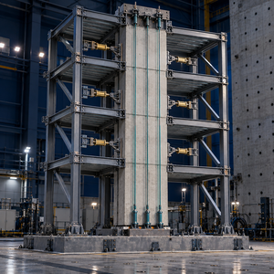
Conceptual visualisation of a rigid rocking core and restoring tendons within a laboratory frame. It does not reproduce a tested specimen from the source paper.
Replaceable Components Change the Repair Problem
Conventional ductile design often allows yielding in primary structural members or their connections. That response can dissipate energy effectively, but it may spread damage across the building and leave permanent deformation. The paper instead favours replaceable energy-dissipating devices at selected, accessible locations.
These devices act as structural fuses. They are intended to yield before the protected members, concentrate damage and remain accessible for inspection. After the earthquake, damaged devices could be removed to reduce the global residual stiffness and then replaced after the structure has been realigned. The practical benefit depends on reliable capacity design, realistic connection behaviour and sufficient access for post-event work.
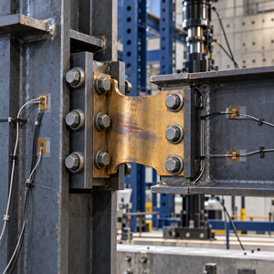
Conceptual visualisation of an accessible replaceable energy-dissipating connection. The image is not a photograph of a device tested in the source study.
Recentering Depends on the Right Balance
Restoring force must be selected carefully. The analytical cases in the paper illustrate three possible outcomes. Too little restoring force leaves a residual moment and prevents complete realignment. Too much may satisfy the recovery objective but produce unnecessary strength and cost. A balanced configuration achieves idealised recentering in the analytical model.
This balance is one reason the authors distinguish the effective stiffness and effective period from the elastic properties of an undamaged building. Once yielding and cracking develop, the structure responds around a different state. The proposed calculations therefore use displacement objectives and secant stiffness at the expected response level instead of relying only on the initial elastic period.
The recovery sequence proposed by the paper can be expressed in practical terms:
- The earthquake-resisting systems control the lateral response while designated devices dissipate energy.
- Damage is concentrated in accessible components rather than distributed indiscriminately through the gravity system.
- The rocking core and restoring mechanism reduce residual deformation and maintain a path toward alignment.
- Engineers inspect the building, remove or replace damaged devices and adjust restoring forces when required.
- The structure is reassessed before repair completion and reoccupation.
Fail Safe Capacity for Unexpected Conditions
Earthquake demand and post-event operations contain uncertainties. The paper therefore adds fail-safe devices that can provide reserve strength if a replaceable link or another local component approaches an undesirable condition. A fail-safe element is intended to permit controlled local damage without complete loss of load-carrying capacity.
In one analytical moment-frame example, approximately 30 percent of the beam strength remained underused in the examined configuration. The proposed fail-safe detail could mobilise part of that reserve and delay local failure. The device increases capacity rather than stiffness, and the reported percentage belongs only to that analytical example. It should not be treated as a general design value.
Why Recovery Can Support Sustainability
The sustainability argument follows from service-life preservation. If engineers can confine damage, restore alignment and replace selected components, a building may avoid demolition after a major earthquake. That outcome could reduce waste, replacement materials, reconstruction activity and disruption to occupants and communities.
The source paper does not report a life-cycle assessment or a measured carbon reduction. Environmental benefits therefore remain a design rationale rather than a quantified result. Future studies will need to compare embodied impacts, repair scenarios, downtime and replacement cycles across conventional and recovery-oriented systems.
Evidence Still Needed
The work provides analytical cases, proposed structural details and a framework for sustainable seismic design. It does not establish a universally validated system. Several questions must be resolved before broad implementation:
- Full-scale cyclic and shake-table validation of the complete structural archetype.
- Sensitivity to construction tolerances, material variability and connection slip.
- Long-term durability of tendons, rocking interfaces, fuses and fail-safe devices.
- Inspection access, replacement procedures and worker safety after an earthquake.
- Repair time, life-cycle cost and environmental performance compared with conventional systems.
- Interaction with facades, partitions, services and other non-structural components.
- Integration with code approval procedures and project-specific seismic hazard requirements.
- Soil-foundation behaviour, which lies outside the scope of the source paper.
From Earthquake Survival to Structural Recovery
The central proposal is to make recovery part of the structural concept. Earthquake damage should occur in known, accessible and replaceable locations. The main gravity system should remain protected. A dedicated restoring path should help reduce residual drift, and fail-safe details should provide reserve capacity for conditions that the primary design does not fully anticipate.
This approach could extend building service life and reduce the need for post-earthquake demolition. Its promise remains conditional on experimental evidence, constructability, maintenance and project-specific validation. For now, the paper provides a technically detailed basis for asking a useful design question: should seismic performance be judged only by whether a building remains standing, or also by how effectively it can recover?
Could the next generation of seismic design measure success by recovery as well as survival?
Source Article
Tehrani, F. M., Grigorian, M., and Gorji Sinaki, F. (2026). Analytical Cases of Sustainable Seismic Design. Journal of Civil Engineering and Materials Application, 10(2). https://doi.org/10.22034/jcema.2026.585508.1203
Read the published article on JCEMA: https://www.jcema.com/article_245148.html
Editorial note This research insight summarises the authors’ analytical framework for a general engineering audience. The generated visuals are conceptual illustrations and should not be interpreted as photographs of tested specimens or completed buildings.