
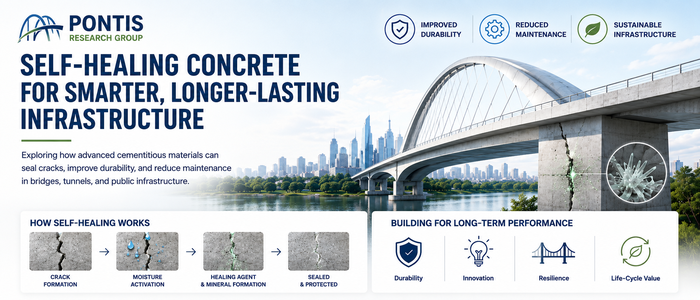
Self-Healing Concrete: Can Infrastructure Repair Its Own Cracks?
”””””””””””””””””””””””””””’
Why This Matters
Concrete is one of the most important construction materials in the world, forming the backbone of bridges, buildings, tunnels, dams, foundations, and transportation infrastructure.
But concrete has an unavoidable weakness: cracking. Some cracks are small and have little immediate effect on structural capacity. However, even small cracks can create pathways for water, chlorides, carbon dioxide, and other aggressive agents to enter the concrete. Over time, this can accelerate reinforcement corrosion, deterioration, and costly maintenance.
| What if concrete could respond to these cracks automatically? |
This is the idea behind self-healing concrete – an emerging class of cementitious materials designed to partially or fully close small cracks with little or no external repair intervention.
What Is Self-Healing Concrete?
Concrete already possesses a limited natural ability to heal very small cracks. When unhydrated cement particles come into contact with water, additional hydration can occur, while calcium-based compounds may precipitate inside cracks and gradually seal part of the opening. This phenomenon is known as autogenous healing.
Researchers are also developing autonomous self-healing systems in which specific healing mechanisms are deliberately incorporated into the concrete and designed to activate when cracking occurs.
| Approach | How it works | Potential engineering value |
| Autogenous healing | Natural hydration and mineral precipitation close small cracks. | Simple mechanism with no additional healing agent. |
| Bacteria-based healing | Protected microorganisms promote mineral precipitation inside cracks. | Can improve crack sealing and reduce permeability. |
| Microcapsules | Embedded capsules rupture when a crack reaches them and release a healing agent. | Provides a localized and automatic crack response. |
| Crystalline additives | Reactive compounds form crystals when exposed to moisture. | Can help block water pathways through small cracks. |
| Superabsorbent polymers | Polymers absorb water, swell, and support internal healing processes. | Can assist crack closure and moisture management. |
Bacteria That Help Repair Concrete
One of the most fascinating approaches involves microbial self-healing concrete. Selected microorganisms can remain protected inside the concrete matrix until moisture enters through a crack. Under suitable conditions, biological activity can promote the formation of calcium carbonate or other mineral products.
These minerals accumulate inside the crack and help seal the opening. The concept transforms concrete from a completely passive material into a system capable of responding to its environment.
A major research challenge is keeping the microorganisms viable inside concrete’s highly alkaline environment. For this reason, researchers are investigating protective carriers such as capsules, porous aggregates, lightweight aggregates, and recycled materials.
From Crack Closure to Structural Durability
The real engineering value of self-healing concrete goes beyond making a crack disappear visually. Cracks provide pathways through which aggressive substances can penetrate deeper into reinforced concrete.
If a healing mechanism can reduce these pathways, it may help slow processes associated with:
- Reinforcement corrosion
- Water penetration
- Chloride ingress
- Freeze-thaw deterioration
- Chemical attack
For infrastructure owners, the potential benefit is significant: a material capable of slowing its own deterioration could reduce maintenance interventions and extend service life.
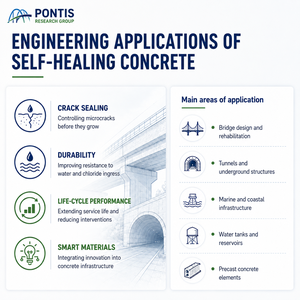
Figure 1. Potential engineering applications and performance objectives for self-healing concrete.
Where Could Self-Healing Concrete Be Used?
The technology could be particularly valuable where inspection and repair are difficult, expensive, or disruptive.
| Infrastructure application | Why self-healing could be valuable |
| Bridges | Can limit the impact of small cracks exposed to moisture and deicing salts. |
| Tunnels | Can help control water penetration in difficult-to-access structural elements. |
| Marine structures | May provide additional protection in aggressive chloride-rich environments. |
| Retaining structures | Can support long-term durability where moisture exposure is continuous. |
| Concrete tanks and reservoirs | Crack sealing can help improve water tightness. |
| Underground infrastructure | May reduce dependence on difficult repair interventions. |
| Precast elements | Healing technologies can potentially be integrated under controlled manufacturing conditions. |
The greatest value may not be in replacing conventional repair methods, but in delaying the moment when major repairs become necessary.
Self-Healing Concrete and Sustainable Infrastructure
Durability and sustainability are closely connected. A structure that lasts longer generally requires fewer repairs, fewer replacement materials, less demolition, and fewer construction interventions during its service life.
This means self-healing technology could contribute to sustainability not only through material innovation, but through life-cycle extension. Instead of focusing only on reducing the environmental impact of concrete at the moment it is produced, engineers can also ask: how can we make the concrete already in service perform effectively for longer?
This shift from initial material efficiency toward full life-cycle performance is becoming increasingly important in sustainable infrastructure design.
Current Engineering Challenges
Despite its potential, self-healing concrete is not yet a universal solution. Moving from laboratory research to large-scale infrastructure requires engineers to understand how healing systems perform under realistic environmental and structural conditions.
Important questions remain around long-term reliability, repeated cracking, compatibility with reinforcement, mechanical performance, manufacturing cost, quality control, environmental conditions, and the ability to produce the material consistently at construction scale.
Another important issue is verification. Engineers need reliable methods to determine not only whether a crack has visually closed, but whether important properties such as permeability, durability, stiffness, or structural performance have actually been recovered.
Combining Self-Healing Materials with Smart Infrastructure
An especially interesting future direction is the combination of self-healing materials and structural health monitoring. Sensors could detect cracking or unusual structural behavior while the material itself responds locally to minor damage.
Artificial intelligence and digital twins could then analyze monitoring data, evaluate whether the healing process has been effective, and identify areas requiring further inspection.
| Detect -> Evaluate -> Respond -> Continue operating |
This represents an important step toward more adaptive and resilient civil infrastructure.
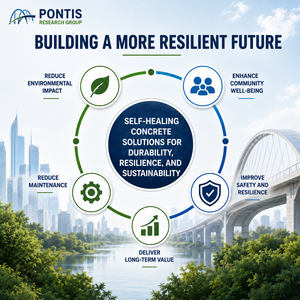
Figure 2. Self-healing materials can contribute to durability, resilience, sustainability, and long-term infrastructure value.
Looking Ahead
Self-healing concrete represents a broader change in the philosophy of structural materials. Traditionally, engineers design materials primarily to resist deterioration. The next generation of materials may also be designed to respond to deterioration when it begins.
Significant research is still required before autonomous healing systems become common in everyday construction. Cost, scalability, long-term validation, design standards, and field performance will ultimately determine how widely these technologies are adopted.
| Instead of asking only how strong a material is, future engineers may increasingly ask: how intelligently can the material respond when damage occurs? |
PontisRG Insight
At Pontis Research Group, we see self-healing concrete as part of the transition toward more intelligent and durable infrastructure. Combining advanced cementitious materials with structural health monitoring, computational modelling, artificial intelligence, and life-cycle engineering could create infrastructure that is not only stronger at the time of construction, but more capable of maintaining its performance throughout decades of service.
The future of concrete may therefore depend not only on preventing cracks – but also on developing materials capable of responding when those cracks inevitably appear.
Key Takeaways
- Self-healing concrete aims to automatically close or seal small cracks before they develop into larger durability problems.
- Healing mechanisms can include natural cement reactions, microorganisms, microcapsules, crystalline materials, and smart polymers.
- The main engineering opportunity is improved durability and potentially reduced maintenance over the structural life cycle.
- Bridges, tunnels, marine structures, tanks, and underground infrastructure are promising applications.
- Combining self-healing materials with structural health monitoring, AI, and digital twins could contribute to a new generation of adaptive infrastructure.
- Long-term field validation, cost, scalability, and design standards remain important research challenges.
Pontis Research Group | Research for resilient, intelligent, and sustainable infrastructure