
Project overview
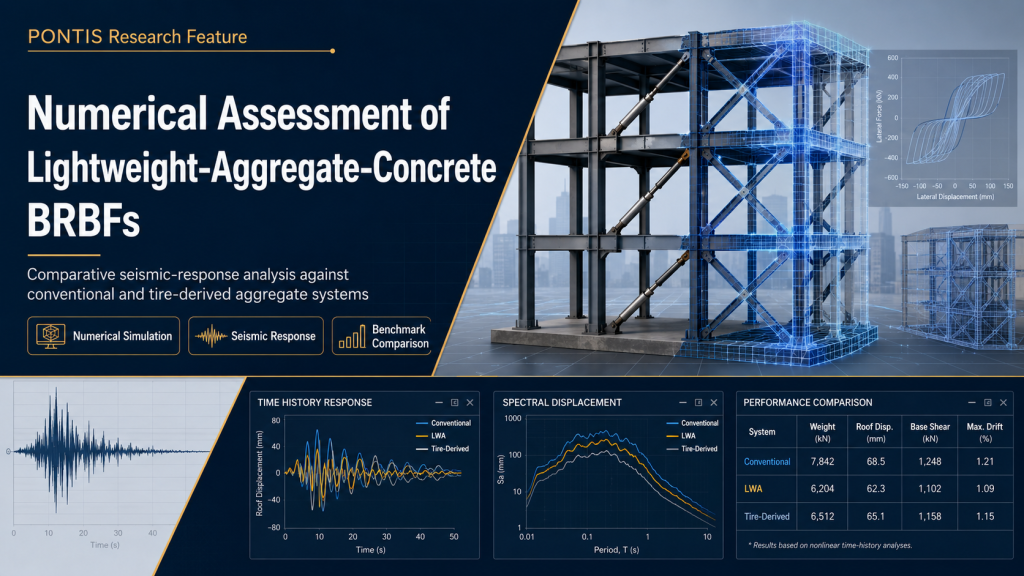
This project presents a software-oriented assessment of the seismic response of lightweight-aggregate-concrete (LWA) buckling-restrained braced frame systems. The work focuses on processing dynamic response data, extracting system-level indicators, and comparing the LWA configuration with conventional concrete and tire-derived aggregate concrete benchmark systems.
The purpose is to understand whether reducing the density of the restraining medium can improve the global seismic behavior of a BRBF system, or whether it introduces unfavorable trade-offs in stiffness, deformation demand, and energy dissipation. The project is framed as a numerical-response and comparative analysis study, rather than as a laboratory testing program.
The numerical-response interpretation and comparative project presentation are centered on the contributors involved in the computational and analytical assessment of the LWA BRBF response.
| Contributor | Role in this project | Affiliation |
| Farzad Naseri | Numerical response analysis, benchmark comparison, seismic-performance interpretation | Politecnico di Torino, Turin, Italy |
| Farmehr M. Dehkordi, PhD | Computational interpretation, response-processing review, project documentation | Politecnico di Torino, Turin, Italy |
Buckling-restrained braces are used to improve the seismic performance of braced frames by preventing brace buckling and promoting stable axial response. Their effectiveness depends not only on the steel core, but also on the restraining medium that controls confinement, force transfer, stiffness, deformation demand, and energy dissipation.
Lightweight aggregate concrete is attractive because it can reduce self-weight and related inertial demand. However, lower density does not automatically lead to better seismic response. For BRBF systems, a restraining medium must also provide adequate confinement and dissipative behavior. This project therefore evaluates the LWA system at the frame-response level rather than relying only on material-level assumptions.
The project uses a comparative numerical-response framework based on processed acceleration and displacement histories. The LWA BRBF response is interpreted through a common set of engineering indicators and compared with benchmark conventional concrete and tire-derived aggregate concrete systems.
The workflow is intentionally software-oriented: response records are processed, dynamic indicators are extracted, and the LWA configuration is compared against benchmark systems using consistent frame-level measures. This approach helps clarify whether the LWA restraining configuration improves seismic efficiency or instead shifts the system toward greater flexibility with insufficient energy dissipation.
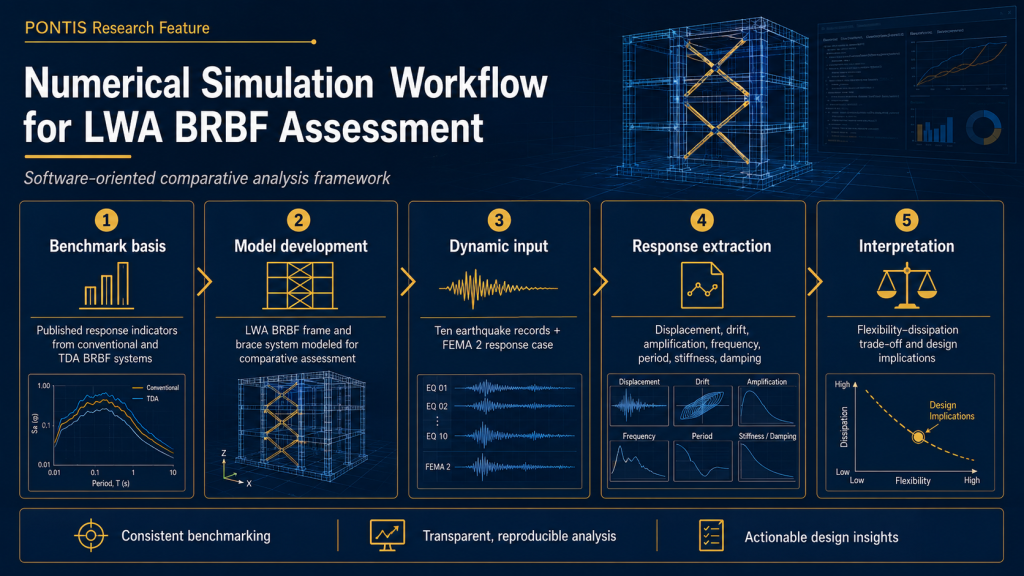
Figure 1. Numerical simulation and response-processing workflow for LWA BRBF assessment.
The numerical-response interpretation focuses on five system-level characteristics: displacement demand, frame rotation, dynamic flexibility, damping behavior, and the balance between flexibility and energy dissipation. These parameters are more meaningful for BRBF performance than a single material property because they describe the behavior of the full frame-brace system under dynamic loading.
- Displacement demand was evaluated from processed base and roof displacement histories.
- Acceleration amplification was used to assess sensitivity to input ground motion and frequency content.
- Equivalent frequency, natural period, and effective stiffness were used to characterize dynamic flexibility.
- Damping ratio was used as a relative measure of energy-dissipation capacity.
- The combined response was interpreted as a flexibility-dissipation trade-off.
The LWA BRBF system showed substantial record-to-record variability under the selected earthquake inputs. Peak acceleration amplification ranged from 0.040 to 4.538, while maximum relative roof displacement reached 277.1 mm. This indicates that the response of the system is highly sensitive to the characteristics of the input ground motion.
The benchmark comparison shows that the LWA system occupied the more flexible side of the response envelope. The averaged equivalent frequency of the LWA specimen was 24.25 rad/s, compared with 50 rad/s for the conventional benchmark and 51.35 rad/s for the TDA benchmark. The corresponding natural period increased to 0.26 s, compared with 0.125 s for both benchmark systems.
The effective stiffness of the LWA specimen was also lower than the benchmark systems. More importantly, the averaged damping ratio was 6.395%, compared with 15.000% for conventional concrete and 21.000% for TDA concrete. This result indicates that the LWA configuration increased flexibility without providing comparable energy dissipation.
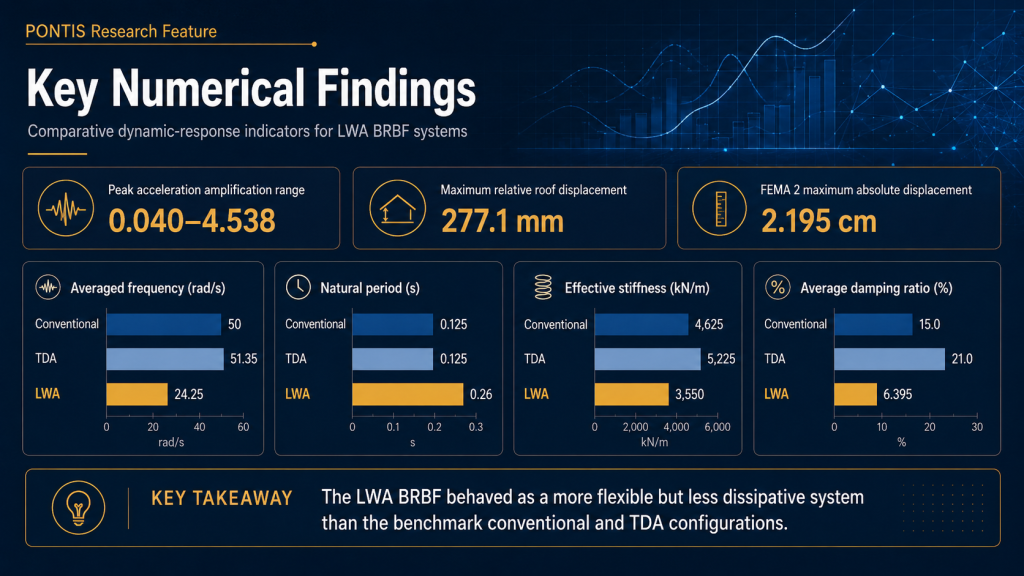
Figure 2. Key numerical findings from the comparative dynamic-response assessment.
| Indicator | Conventional | TDA | LWA |
| Averaged frequency | 50 rad/s | 51.35 rad/s | 24.25 rad/s |
| Natural period | 0.125 s | 0.125 s | 0.26 s |
| Equivalent modulus | 63,000 MPa | 66,500 MPa | 16,250 MPa |
| Effective stiffness | 4,625 kN/m | 5,225 kN/m | 3,550 kN/m |
| Average damping ratio | 15.000% | 21.000% | 6.395% |
The analysis indicates that the LWA BRBF system behaved as a more flexible but less dissipative system compared with the benchmark conventional concrete and TDA concrete configurations. This is a critical conclusion because seismic performance cannot be improved by density reduction alone. A lightweight restraining medium must still maintain sufficient confinement, stiffness, and energy-dissipation capacity.
The LWA configuration remains attractive from a sustainability and self-weight reduction perspective, but the current response pattern suggests that additional design improvements are required before similar seismic efficiency can be achieved. The most important improvement areas are interface control, confinement quality, brace detailing, and mechanisms that increase hysteretic or frictional energy dissipation.
- The project clarifies the system-level consequences of using LWA concrete as a restraining medium in BRBF applications.
- It shows that lower mass can reduce some inertial effects, but may also increase flexibility and deformation demand.
- It provides a response-based comparison framework for evaluating alternative sustainable restraining materials.
- It supports future numerical and design studies aimed at improving lightweight BRBF systems through better confinement and detailing.
- It demonstrates why BRBF assessment should consider displacement, frequency, period, stiffness, and damping together.
- The LWA BRBF response was highly sensitive to earthquake record characteristics.
- Maximum relative roof displacement reached 277.1 mm in the processed response dataset.
- The LWA system had lower frequency and longer period than the benchmark systems, indicating greater flexibility.
- The LWA system had substantially lower damping than both conventional and TDA concrete systems.
- Reduced restraining-medium density alone is not sufficient to improve seismic performance.
- Improved interface control, confinement, and energy-dissipation mechanisms are essential for future LWA BRBF development.
This project profile is based on the dynamic-response study titled “Dynamic Response of Lightweight-Aggregate-Concrete BRBFs: Comparison with Conventional and Tire-Derived Concrete Systems.” The website project framing has been adapted to emphasize numerical response processing, software-oriented comparison, and engineering interpretation of system-level BRBF behavior.