
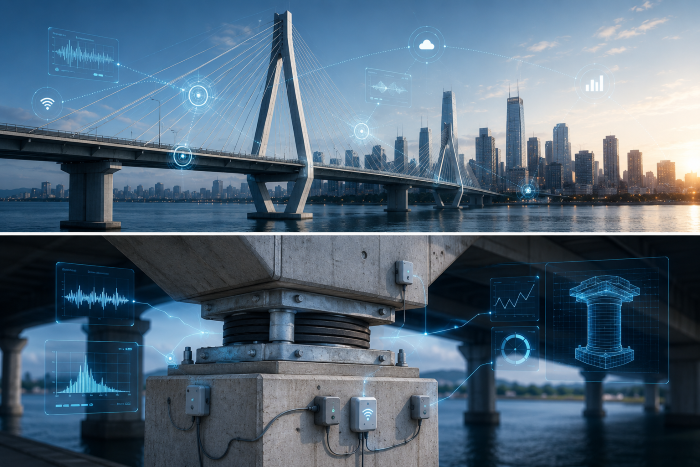
The Role of Artificial Intelligence in Structural Health Monitoring and Infrastructure Safety
As infrastructure around the world continues to age, ensuring the safety and reliability of bridges, buildings, and other critical structures has become increasingly important. Traditional inspection methods often require significant time, cost, and human resources while still leaving room for undetected damage.
Artificial Intelligence (AI) is rapidly transforming Structural Health Monitoring (SHM) by enabling continuous, automated, and data-driven assessment of structural performance.
How AI Improves Structural Health Monitoring
Modern SHM systems collect large volumes of data from sensors measuring:
- Acceleration
- Strain
- Displacement
- Vibration
- Temperature
- Acoustic emissions
Machine learning algorithms analyze these datasets to identify abnormal structural behavior before visible damage occurs.
Unlike conventional inspection techniques, AI systems continuously learn from historical data and improve their prediction accuracy over time.
Key Technologies
Several AI technologies are now being integrated into structural engineering:
- Deep Learning
- Computer Vision
- Digital Twins
- Internet of Things (IoT)
- Edge Computing
- Predictive Analytics
Together, these technologies provide engineers with real-time insights into structural performance.
Practical Applications
AI-powered monitoring is already being applied to:
- Long-span bridges
- High-rise buildings
- Tunnels
- Offshore platforms
- Railway infrastructure
- Wind turbines
Many infrastructure owners now rely on automated monitoring systems to reduce maintenance costs while improving public safety.
Future Challenges
Despite remarkable progress, several challenges remain:
- High-quality training datasets
- Sensor reliability
- Model interpretability
- Cybersecurity
- Standardization
- Integration with existing infrastructure
Researchers continue to address these challenges through interdisciplinary collaboration.
Looking Ahead
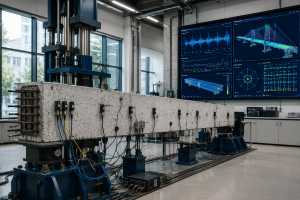
Artificial Intelligence is expected to become a core component of next-generation structural engineering. By combining advanced sensing technologies with intelligent algorithms, engineers can shift from reactive maintenance toward predictive infrastructure management.
Pontis Research Group is committed to exploring innovative research in AI, structural engineering, and digital technologies to support safer and more resilient infrastructure worldwide.