
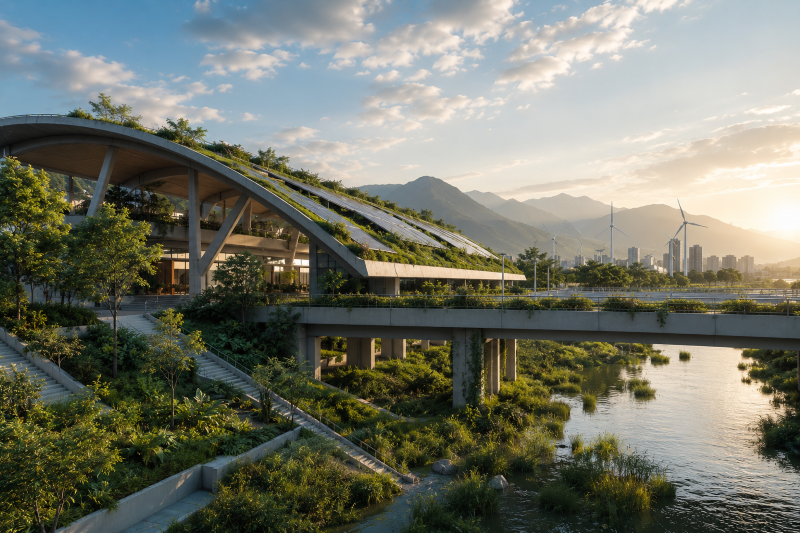
Beyond Concrete: How Environmental Intelligence Is Redefining Structural Engineering
The Next Challenge Isn’t Strength—It’s Sustainability
For decades, structural engineering has been driven by one central objective: building stronger and safer structures. Today, however, engineers face a new challenge. Every bridge, building, and transportation network must not only withstand physical loads but also respond to environmental pressures throughout its entire life cycle.
Environmental performance is becoming as important as structural performance.
Looking Beyond Carbon
Reducing carbon emissions is an important goal, but environmental engineering extends much further.
A modern infrastructure project influences water resources, biodiversity, energy consumption, material extraction, construction waste, and long-term maintenance. Decisions made during the earliest design stages often determine environmental impacts that last for decades.
Rather than asking “How strong is this structure?”, engineers increasingly ask:
- How efficiently does it use resources?
- Can it adapt to future climate conditions?
- How easily can materials be reused?
- What environmental footprint will remain after its service life?
Designing for an Uncertain Climate
Climate models indicate that future infrastructure will experience conditions very different from those considered in traditional design standards.
Extreme rainfall, prolonged heatwaves, stronger wind events, flooding, and changing groundwater conditions all influence structural behavior.
Environmental engineering encourages designers to think beyond today’s climate and prepare infrastructure for tomorrow’s uncertainties through resilient design strategies.
Nature as an Engineering Partner
Instead of resisting natural processes, many modern projects work alongside them.
Green roofs reduce urban temperatures.
Vegetated embankments minimize erosion.
Permeable pavements improve stormwater management.
Restored wetlands protect transportation corridors from flooding.
These nature-based solutions often improve structural resilience while reducing environmental impacts.
Measuring Success Differently
Historically, infrastructure success was measured by construction cost and service life.
Today, engineers evaluate projects using additional indicators such as:
- Life-cycle carbon emissions
- Resource efficiency
- Water consumption
- Ecological impact
- Maintenance requirements
- End-of-life recyclability
This broader perspective enables infrastructure owners to make decisions that remain sustainable for generations.
Innovation Through Collaboration
Environmental engineering is no longer confined to a single discipline.
Structural engineers now collaborate with environmental scientists, ecologists, urban planners, geotechnical engineers, transportation specialists, and data scientists to develop infrastructure systems that balance safety, performance, and sustainability.
This interdisciplinary approach is becoming essential for addressing increasingly complex engineering challenges.
The Road Ahead
Future infrastructure will not simply be larger or stronger—it will be smarter, cleaner, and more adaptable.
Emerging technologies such as Digital Twins, AI-assisted environmental monitoring, low-carbon materials, and circular construction practices are transforming how engineers evaluate environmental performance throughout an asset’s life cycle.
As research continues to evolve, environmental intelligence will become a fundamental component of structural engineering rather than an additional consideration.
Final Thoughts
The future of infrastructure depends on more than engineering excellence alone. It requires understanding how structures interact with the natural environment over decades of operation.
By integrating environmental thinking into every stage of planning, design, construction, and maintenance, engineers can create infrastructure that is not only resilient but also responsible.
At Pontis Research Group, we believe that the next generation of infrastructure will be defined by the balance between innovation, sustainability, and long-term environmental stewardship.