
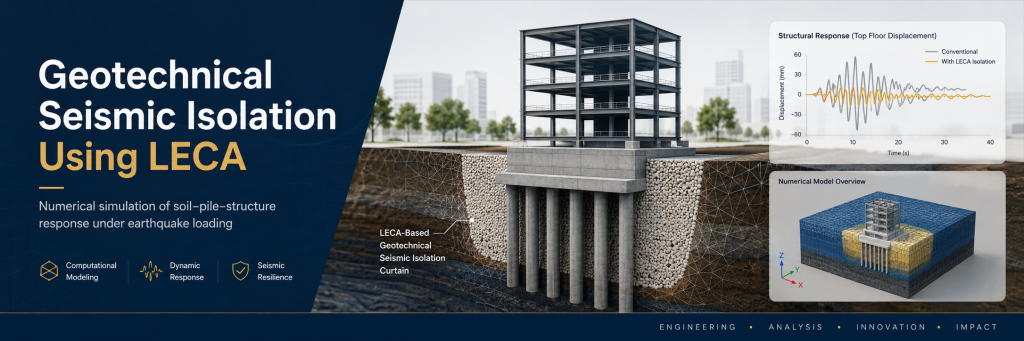
Project overview
This project develops a numerical simulation framework for evaluating the dynamic response of soil-pile-structure systems protected by a lightweight expanded clay aggregate isolation curtain. The central idea is to study how a geotechnical isolation layer placed around the foundation zone can modify the transfer of seismic energy from the surrounding soil to the supported structure.
Instead of presenting the work as a laboratory campaign, the project is framed as a computational and engineering interpretation of an isolated versus non-isolated system. The focus is on model definition, dynamic input processing, extraction of structural response parameters, and comparison of seismic performance indicators.
| Project focus | Numerical simulation and dynamic response assessment of LECA-based geotechnical seismic isolation. |
| System type | Soil-pile-structure system with a lightweight expanded clay aggregate isolation curtain. |
| Main comparison | Baseline non-isolated condition versus LECA-isolated condition. |
| Primary outputs | Damping ratio, structural period, drift, and response comparison under earthquake loading. |
| Project contributors | Farmehr M. Dehkordi and Farzad Naseri. |
| Scientific guidance | Prof. Fariborz M. Tehrani. |
Engineering background and motivation
Earthquake loading can generate severe deformation demands in structures supported by shallow or deep foundations. The dynamic response is strongly influenced by the interaction between the structure, foundation, piles, and surrounding soil. For this reason, seismic protection cannot be evaluated only at the superstructure level; the soil and foundation system must also be considered.
Geotechnical seismic isolation introduces a material or geometric discontinuity in the ground to reduce the direct transmission of seismic waves. In this project, lightweight expanded clay aggregate is considered as the isolation medium. LECA is attractive because of its low density, high porosity, granular behavior, and potential to absorb and dissipate part of the seismic energy before it reaches the structural system.
The numerical interpretation compares two configurations: a baseline non-isolated soil-pile-structure model and an isolated model in which a LECA curtain surrounds the foundation region. The goal is to quantify how this modification changes damping, period, drift, and overall response demand.
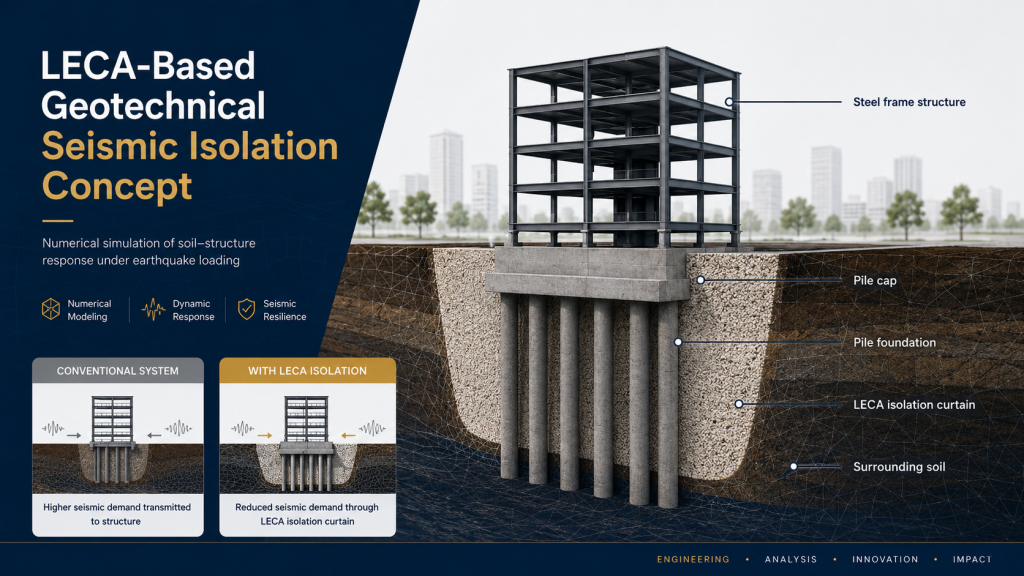
Figure 1. Conceptual numerical model: baseline condition and LECA-isolated soil-pile-structure system.
Numerical modeling strategy
The computational workflow begins with the definition of the soil profile, foundation geometry, pile group, structural frame, and LECA isolation zone. These components are represented as a coupled soil-pile-structure system so that changes in the foundation environment can influence the dynamic response of the supported structure.
Two parallel models are considered. The first model represents the conventional configuration without a geotechnical isolation curtain. The second model introduces the LECA region around the foundation system. This paired-model strategy makes the comparison direct, because the observed differences can be attributed to the isolation concept rather than to unrelated modeling assumptions.
Earthquake input motions are applied at the base of the model, and the response is extracted at key locations of the structure and foundation system. The main post-processing quantities are effective damping ratio, fundamental structural period, interstory drift, and displacement response. These indicators allow the numerical results to be interpreted in terms of both dynamic behavior and practical engineering performance.
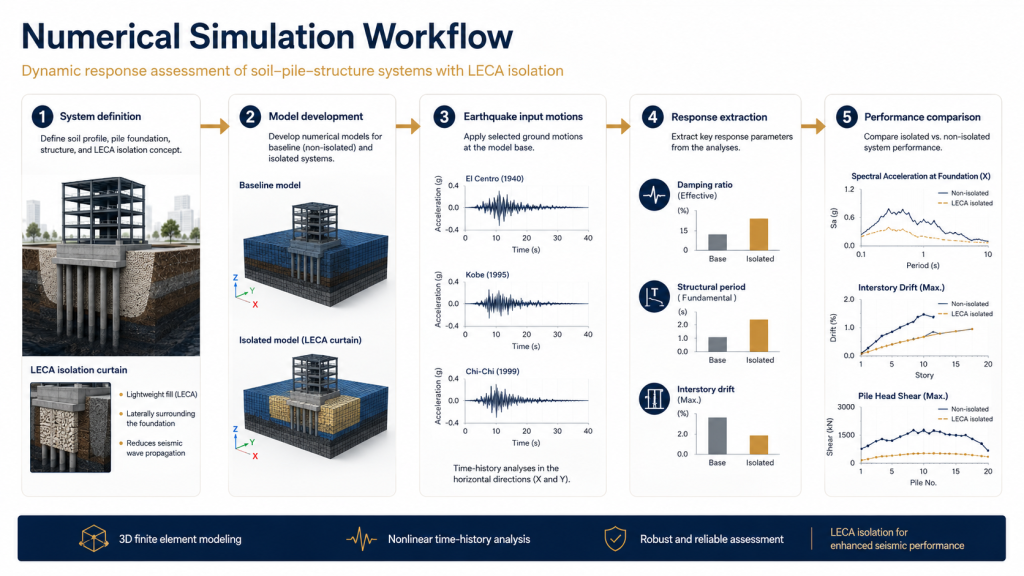
Figure 2. Numerical simulation workflow used for dynamic response assessment and performance comparison.
Key numerical response indicators
The response comparison indicates that the LECA-isolated configuration modifies the dynamic characteristics of the soil-pile-structure system. The isolated condition shows a higher mean damping ratio, a longer structural period, and a small reduction in the mean drift response. These trends suggest that the isolation curtain can increase energy dissipation and alter the frequency characteristics of the coupled system.
| Response metric | Non-isolated | LECA-isolated | Numerical interpretation |
| Mean damping ratio | 0.022 | 0.035 | Increase of about 59.1%, indicating improved energy dissipation. |
| Mean structural period | 0.380 s | 0.424 s | Increase of about 11.6%, indicating a more flexible dynamic response. |
| Mean drift | 0.0234 m | 0.0215 m | Reduction of about 0.0019 m in the overall mean drift response. |
| Impulse response | 0.027 | 0.053 | Isolated case showed nearly doubled damping response under impulse loading. |
| Loma Prieta response | 0.035 | 0.087 | Marked increase in damping, showing stronger energy dissipation for this record. |
| Sweep at 1 Hz | 0.031 | 0.078 | Higher damping under harmonic excitation and improved vibration attenuation. |
The damping ratio increased from 0.022 in the non-isolated configuration to 0.035 in the isolated configuration. This corresponds to an improvement of approximately 59.1%. The mean structural period increased from 0.380 s to 0.424 s, corresponding to an increase of approximately 11.6%. The mean drift decreased from 0.0234 m to 0.0215 m, giving a reduction of approximately 0.0019 m.
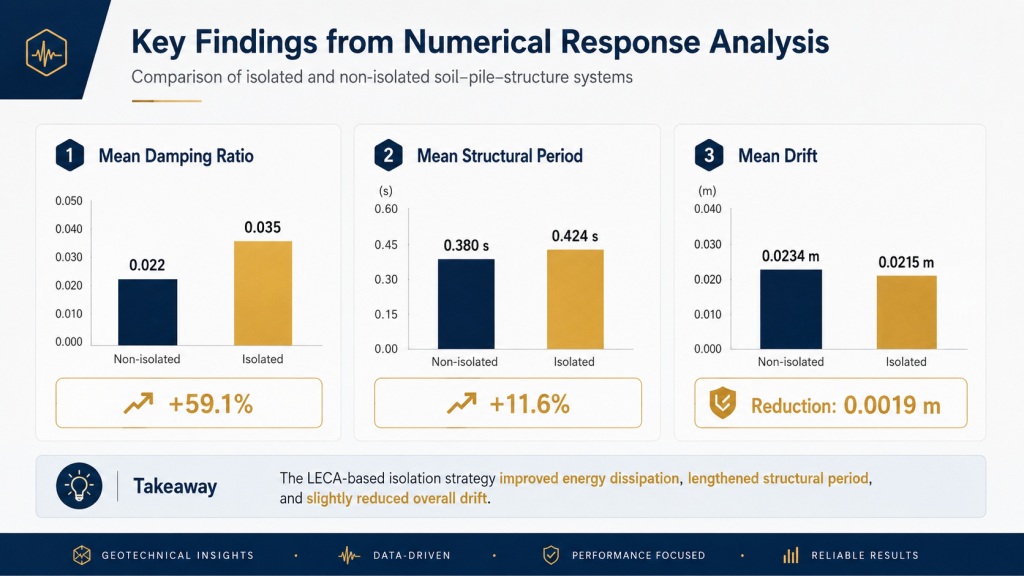
Figure 3. Main numerical response indicators for the isolated and non-isolated systems.
Engineering interpretation
The results show that a LECA-based geotechnical isolation curtain can be interpreted as a response-modifying layer within the soil-foundation domain. By changing the stiffness, mass, and energy-dissipation characteristics around the foundation system, the isolation zone can reduce the intensity of motion transmitted to the superstructure and alter the dynamic characteristics of the coupled system.
The increase in damping is particularly important from a seismic design perspective because higher damping can reduce vibration amplitude and improve energy dissipation. The increase in structural period suggests a shift of the dynamic response toward a more flexible behavior, which can help reduce resonance with damaging frequency components of earthquake motion.
The drift response requires careful interpretation. The average drift reduction is modest, and individual response components may vary depending on the input motion and the local soil-structure interaction mechanism. This highlights why numerical simulation is important: the isolation system should not be judged only through a single output parameter, but through a complete response assessment.
Practical applications
- Seismic retrofit of existing low- to medium-rise structures where conventional base isolation may be difficult or expensive.
- Preliminary assessment of geotechnical isolation strategies for buildings supported by pile foundations.
- Development of low-cost seismic protection concepts based on lightweight granular materials.
- Parametric studies on the effect of isolation-zone geometry, material properties, soil stiffness, and earthquake intensity.
- Performance-based comparison between conventional soil-pile-structure systems and geotechnically isolated alternatives.
Project significance
This project supports a software-oriented approach to geotechnical seismic isolation. It translates the physical concept of a LECA isolation curtain into a model-based framework that can be evaluated, compared, and improved through numerical simulation. The outcome is a practical basis for future parametric analyses and design-oriented studies on soil-pile-structure interaction under seismic loading.
Keywords
Numerical simulation; geotechnical seismic isolation; LECA; soil-pile-structure interaction; dynamic response; earthquake engineering; damping ratio; structural period; drift; performance-based assessment; computational geotechnics.