
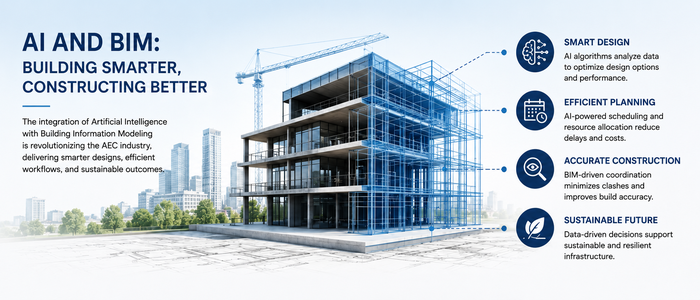
AI and BIM: Building Smarter, Constructing Better
How artificial intelligence and digital models are reshaping design, coordination, and infrastructure delivery
Overview
Building Information Modeling (BIM) has already changed the way engineers, architects, contractors, and owners manage information. Artificial Intelligence (AI) is now adding a new layer to this process: the ability to learn from data, compare design options, detect risks earlier, and support better decisions throughout the life of a project.
The real value is not in replacing engineers. It is in giving them better tools. When AI is connected to reliable BIM data, design teams can test alternatives faster, reduce coordination errors, and make more informed choices about cost, safety, constructability, and sustainability.
Why this matters
Civil engineering projects generate large amounts of information: drawings, models, schedules, quantities, inspection records, sensor data, and design revisions. Much of this information is useful, but it is often fragmented across different teams and software platforms.
AI-assisted BIM can help organize this information and turn it into practical insight. It can highlight design conflicts, compare structural or construction alternatives, estimate risks, and support more efficient project delivery. For infrastructure owners, it can also improve maintenance planning and long-term asset management.
Where AI adds value to BIM
| Project Stage | How AI Supports BIM | Engineering Value |
|---|---|---|
| Concept Design | Evaluates and compares early design alternatives using geometry, quantities, and performance criteria. | Faster identification of feasible and high-performing design options. |
| Detailed Design | Detects clashes, verifies model consistency, and identifies missing or inaccurate information. | Reduces coordination errors, rework, and design revisions. |
| Construction Planning | Integrates BIM data with schedule, cost, and resource constraints to optimize project planning. | Improves construction sequencing, resource allocation, and reduces the risk of delays. |
| Operation & Maintenance | Incorporates inspection records, sensor data, and operational information to continuously update the digital model. | Enhances predictive maintenance, asset management, and long-term operational performance. |
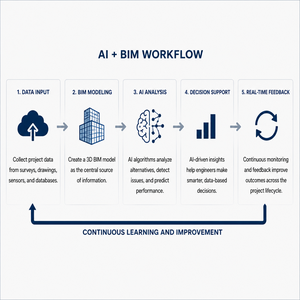
Typical AI-BIM workflow from project data to continuous improvement.
Common applications
• Clash detection and model quality control.
• Automated quantity checks and cost-risk screening.
• Schedule optimization and construction sequencing.
• Design-option comparison for structural and architectural alternatives.
• Support for digital twins and condition-based maintenance.
Impact across the AEC industry
The impact of AI and BIM is strongest when the workflow is transparent. Engineers still need to understand the assumptions behind the model, verify the quality of the data, and make final decisions based on engineering judgment. AI can support the process, but it should not hide the reasoning behind the results.

Main benefits of AI and BIM for project delivery and infrastructure management.
Benefits and cautions
Benefit What it can improve What engineers must check
Productivity Less repetitive checking and faster comparison of options. The model must be complete and well-structured.
Quality Earlier detection of clashes, inconsistencies, and missing data. Automated results must be reviewed by experienced professionals.
Sustainability Better material quantities and improved design-option comparison. Environmental indicators must be defined clearly.
Asset management More informed inspection and maintenance planning. Sensor and inspection data must be reliable and traceable.
Looking ahead
The next step is not simply to create more digital models, but to make them more useful. BIM can become the central source of project information, while AI can help engineers interpret that information and act on it more efficiently.
For civil engineering, this means smarter design workflows, clearer coordination, and better long-term management of infrastructure. The most successful applications will be those that combine reliable data, transparent models, and responsible engineering judgment.
Key takeaways
• AI is most useful when it is connected to clean, structured BIM data.
• The role of engineers remains essential for verification, interpretation, and responsibility.
• AI-BIM workflows can improve productivity, coordination, sustainability, and asset management.
• The best digital tools are not the most complex ones; they are the ones that support better engineering decisions.