
Self-Deploying Reinforced Concrete Could Transform the Future of Construction
Researchers have introduced an innovative self-deploying formwork system that could significantly reduce the time, labor, and material required to construct reinforced concrete structures.
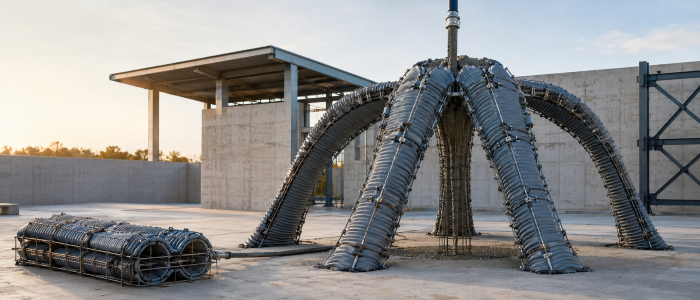
The technology uses interconnected multistable polymer tubes that can be transported in a compact configuration and then automatically expand into a predefined structural form as concrete is pumped into them. Flexible steel cables are incorporated directly into the tubes, providing continuous reinforcement throughout the deployed structure.
In a full-scale experimental demonstration, the researchers successfully deployed a 2.36-meter-high reinforced concrete structure in only 14 seconds. Unlike conventional formwork, which requires extensive on-site assembly and subsequent removal, the proposed system combines the formwork and part of the permanent structural system into a single deployable solution.
More Than Just Rapid Construction
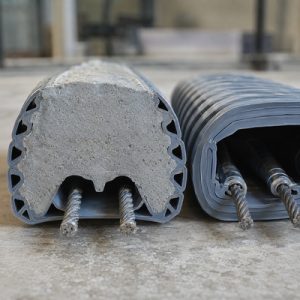
One of the most remarkable findings was the contribution of the polymer tube shell to structural performance. Experimental results showed that concrete elements enclosed by the polymer shell achieved approximately three times the strength of comparable unconfined specimens. This improvement was mainly attributed to the confinement provided by the surrounding shell.
The system also demonstrated the ability to form both conventional and complex geometries, including rectangular, conical, and spherical configurations. Its self-leveling behavior may additionally make it adaptable to uneven terrain.
The proposed construction process consists of three main stages:
- The compact formwork and integrated reinforcement are assembled off-site.
- The system is transported to the construction location.
- Concrete is pumped through a single inlet, causing the structure to deploy automatically under gravity.
This approach could reduce formwork waste, transportation requirements, construction time, and the need for intensive on-site labor.
Structural Challenges Still Remain
Although the results are promising, the technology remains at the proof-of-concept stage. The researchers noted that its performance has not yet been established for full-scale multistory buildings.
Further investigation is required to evaluate:
- Response under earthquakes, wind, and other lateral loads
- Long-term durability of the polymer shell
- Buckling and stability of taller structures
- Reinforcement continuity and floor-to-floor connections
- Fire resistance and environmental exposure
- The full life-cycle impact of single-use polymer components
Why This Research Matters
Formwork is one of the most labor-intensive and material-demanding components of reinforced concrete construction. A system that arrives on-site in a compact form and rapidly transforms into a reinforced structural mold could offer important advantages for emergency housing, remote construction, infrastructure projects, and regions facing shortages of skilled labor.
The study represents an exciting intersection of structural engineering, smart materials, and deployable systems. However, comprehensive structural testing and full-scale validation will be essential before this concept can move from laboratory demonstrations to real buildings.
Source: E. Ben-Abu, A. Zigelman, H. Lipson, et al., “Self-deploying reinforced concrete structures,” Communications Engineering, Vol. 5, Article 133, 2026. Read the original open-access research article