
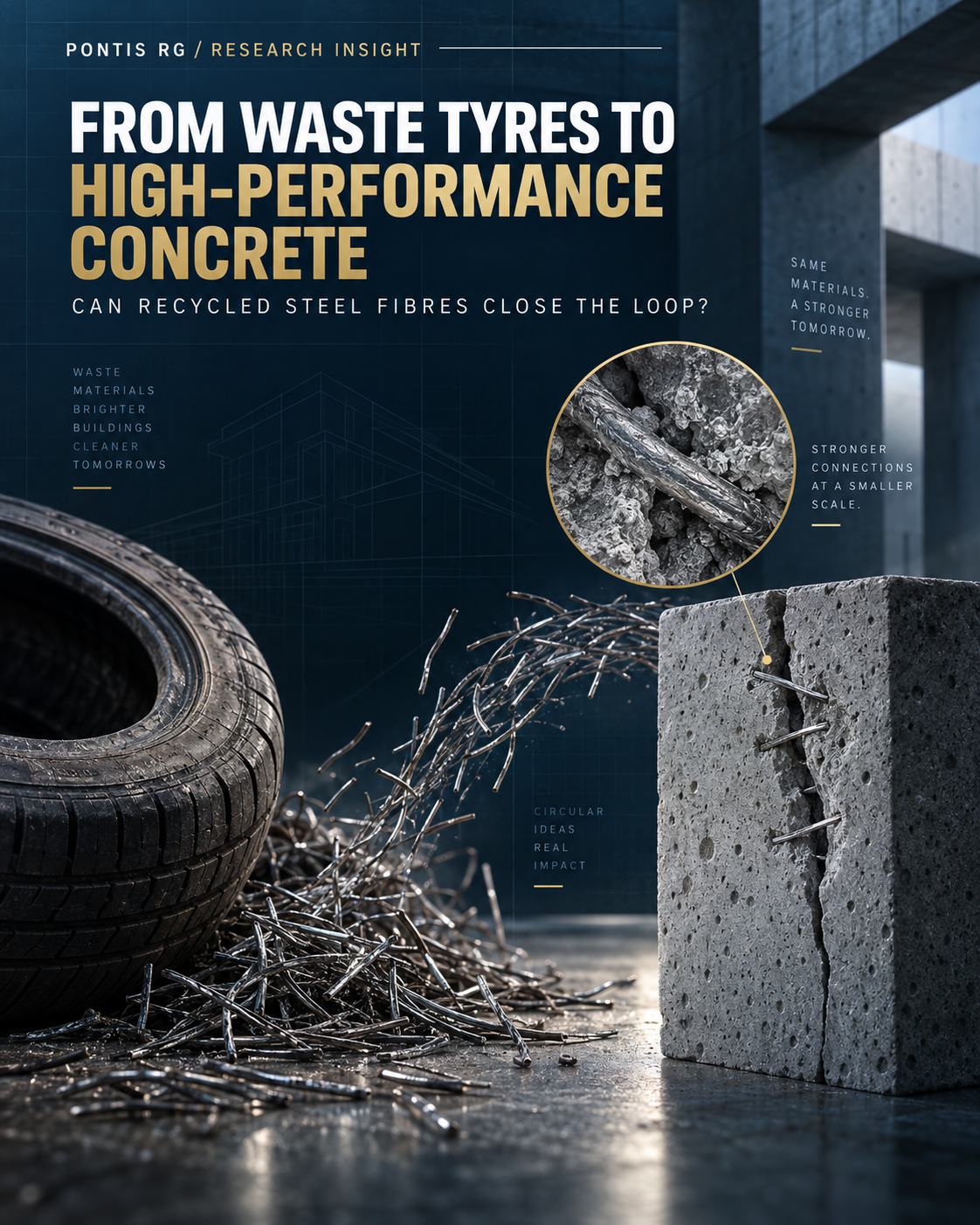
From Waste Tyres to High-Performance Concrete
From Waste Tyres to High-Performance Concrete
Can recycled steel fibres close the loop without compromising structural performance?
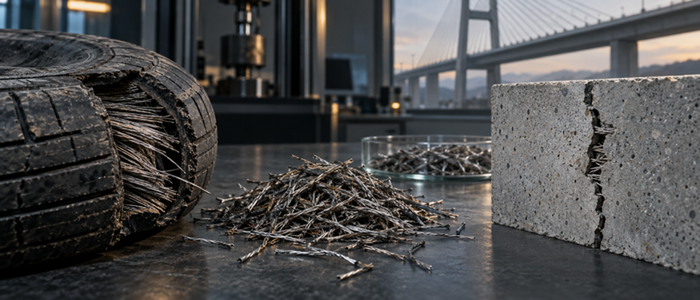
Every end-of-life tyre contains high-strength steel. Meanwhile, fibre-reinforced concrete often depends on newly manufactured steel fibres. Bringing these two material streams together is an attractive circular-economy idea – but its success depends on engineering control, not recycled content alone.
A valuable reinforcement hidden inside a difficult waste stream
Vehicle tyres are engineered composites of rubber, textiles and high-tensile steel cords. During mechanical recycling, the steel fraction can be separated magnetically, cleaned and processed into short fibres. The result is a potential reinforcement source for concrete that would otherwise require purpose-made industrial steel fibres.
The scale of the opportunity is substantial. A University of Sheffield industry case study reports that European construction uses about 120,000 tonnes of new steel fibres each year, while roughly twice that quantity emerges annually as a by-product of end-of-life tyre recycling. The same case study reports that its recovery route used about 5% of the energy required to manufacture fibre from virgin wire [6]. These figures describe a particular industrial pathway, but they show why tyre-derived steel deserves serious attention.
THE REAL QUESTION Can recovered tyre steel be transformed from a variable waste by-product into a classified, predictable and designable reinforcement?
How recycled tyre steel fibres can improve concrete
Concrete is strong in compression but comparatively weak once tensile cracking begins. Dispersed steel fibres can cross developing cracks, transfer stress between the two faces and absorb energy through bond, deformation and pull-out. Short fibres are particularly useful for slowing microcrack growth, while longer fibres can remain active as cracks widen. A well-designed blend can therefore improve post-cracking resistance and toughness.
Tyre-derived fibres can perform the same basic crack-bridging function, but their geometry is less uniform. Length, diameter, curvature and surface condition vary with the tyre source and recycling process. That irregularity can create a useful multi-scale reinforcement effect, yet it can also reduce workability, encourage entanglement and make distribution less predictable. The fibre is not automatically inferior or superior: its performance depends on how it is classified and incorporated.
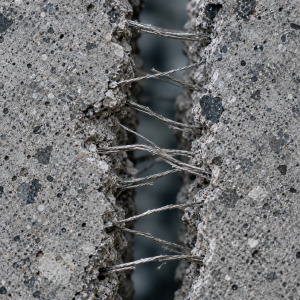
Crack bridging is the central mechanical role: fibres transfer stress and dissipate energy as the fracture opens.
What recent studies tell us
Recent experimental studies provide encouraging evidence, but also a consistent warning against universal claims. Wang and colleagues compared ultra-high-performance concrete (UHPC) containing 2% recycled steel fibre with UHPC containing the same dosage of industrial steel fibre. In that study, the recycled-fibre mixture achieved better flowability and comparable compressive and tensile strength [1]. The researchers linked this response partly to the contribution of shorter fibres in limiting microcrack propagation.
A separate UHPC study by Yu and colleagues found a non-linear response as recycled tyre steel fibre replaced manufactured fibre. Performance first improved and then declined, with a 25% replacement level providing the best overall balance for that specific mixture and test programme [2]. Full replacement did not reproduce the highest compressive strength. The lesson is more important than the percentage itself: an optimum identified for one fibre source, matrix and mixing procedure should not be treated as a universal recipe.
Wu and colleagues likewise reported that recycled tyre steel fibres could provide tensile performance close to industrial fibres under their test conditions in high-performance cement-based materials [3]. Their comparison of UHPC and slurry-infiltrated fibre concrete also showed how the environmental interpretation changes with the amount of fibre used and the performance achieved. A stronger material can carry a larger absolute footprint yet perform more efficiently when emissions are normalised by strength.
The evidence is also expanding beyond isolated material tests. García-Troncoso and colleagues evaluated recycled tyre steel fibre reinforced high-performance cementitious composites from the material scale to full-scale urban concrete elements [5]. This progression toward structural-scale testing is essential because specimen-level strength alone cannot establish constructability, reliability or design performance in real components.
EVIDENCE SNAPSHOT Tyre-derived fibres can approach manufactured-fibre performance, but the result is governed by fibre quality, replacement level, dispersion, matrix design and the chosen performance metric.
Lower impact must be measured – not assumed
The strongest sustainability argument is the possibility of avoiding virgin steel-fibre production while creating a higher-value use for tyre recycling residue. In the life-cycle assessment reported by Wang and colleagues, the 2% recycled-fibre UHPC produced 929.64 kg CO2e/m3 – 23.91% below the corresponding industrial-fibre UHPC. When normalised by compressive strength, the reported carbon intensity was 8.03 kg CO2e/(m3·MPa), 18.1% lower [1]. The study calculated an emission factor of 0.587 kg CO2e per kilogram of recycled steel fibre.
Those values are promising, but they are not universal constants. Transport distance, cleaning and cutting, allocation of recycling burdens, fibre dosage, concrete strength and the electricity mix can change the result. Cement also remains a major contributor to UHPC emissions. Replacing the fibre therefore improves only one part of the system; it does not automatically make the whole concrete low-carbon.
This caution is reinforced by research on conventional concrete containing a hybrid combination of recycled tyre steel and textile fibres. Tariq and colleagues identified 1% recycled tyre steel fibre plus 0.5% recycled tyre textile fibre as the most effective experimental combination in their programme, but the embodied carbon and energy were still slightly higher than the plain control mixture [4]. Mechanical benefit, resource circularity and carbon reduction are related objectives – not interchangeable claims.
Quality control is the bridge to structural use
The main barrier to wider adoption is not whether the steel can reinforce concrete; it is whether engineers can rely on each delivered batch. Commercial fibres are manufactured to controlled geometry and tensile properties. Recycled tyre fibres may arrive with broad length distributions, residual rubber or textile contamination, tangled bundles and source-to-source variability.
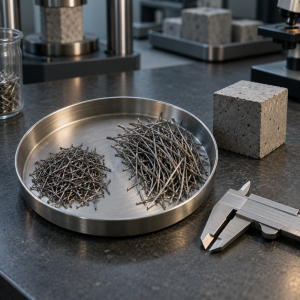
Classification, cleanliness and dimensional control are essential if a recycled by-product is to become a dependable reinforcement product.
Characterise the fibre. Measure length and diameter distributions, curvature, tensile capacity, contamination and batch variability.
Optimise the mixture. Adjust dosage, fibre-length blend, mixing sequence and rheology to prevent balling and achieve uniform dispersion.
Validate durability. Investigate corrosion risk, bond retention, fatigue, freeze-thaw exposure and long-term behaviour in the intended environment.
Prove structural performance. Move from coupons and small beams to representative components, construction trials and reliability-based design evidence.
A controlled substitution, not a universal replacement
The current evidence supports a balanced conclusion. Recycled tyre steel fibres can become an effective reinforcement for UHPC and other high-performance cement-based materials. In well-controlled mixtures, they can preserve important mechanical properties, enhance crack resistance and reduce reliance on manufactured fibres. They may also lower environmental impacts when the recovery process, transport and mixture design are favourable.
However, the strongest pathway is not immediate 100% replacement. It is controlled, performance-based substitution supported by fibre classification, mixture optimisation, durability testing and structural validation. Engineers should specify the behaviour the material must deliver, then determine how much tyre-derived fibre can meet that requirement consistently.
PONTIS PERSPECTIVE Circular construction succeeds when a waste material becomes a reliable engineering material. The goal is not simply to use more recycled fibre – it is to use the right fibre, at the right dosage, with evidence that matches the intended structure.
Can the next generation of high-performance concrete begin inside yesterday’s tyres?
The answer may be yes – provided circular ambition is matched by material control and structural evidence.
References and further reading
[1] Wang, Y., Qiao, P., Sun, J., Li, H., & Chen, A. (2025). Production of ultra high performance concrete using recycled tire steel fiber: mechanical properties and life cycle assessment. Magazine of Concrete Research, 77(9-10), 552-567. https://doi.org/10.1680/jmacr.24.00208
[2] Yu, J., Wu, Q., Zhao, D., & Jiao, Y. (2025). Influence of recycled tire steel fiber content on the mechanical properties and fracture characteristics of ultra-high-performance concrete. Materials, 18(14), 3300. https://doi.org/10.3390/ma18143300
[3] Wu, L., Feng, C., Qiu, J., Wang, L., Peng, Y., & Liu, J. (2025). Influence of recycled tire steel fibers on the mechanical properties and carbon emissions of high-performance cement-based materials. Materials, 18(13), 3008. https://doi.org/10.3390/ma18133008
[4] Tariq, Z., Bahadori-Jahromi, A., & Room, S. (2026). Sustainable incorporation of recycled tire steel and textile fibers as a hybrid mix in concrete. Sustainability, 18(2), 786. https://doi.org/10.3390/su18020786
[5] García-Troncoso, N., et al. (2026). Structural performance of recycled tyre steel fibre reinforced high-performance cementitious composites for urban concrete elements. Journal of Building Engineering, 128, 116471. https://doi.org/10.1016/j.jobe.2026.116471
[6] University of Sheffield. New life for tyre recycling by-products. Faculty of Engineering industry partnership case study. https://sheffield.ac.uk/engineering/about/partnerships/new-life-tyre-recycling-products
Editorial note: This research insight synthesises recent published evidence. Reported values are study-specific and should not be interpreted as universal design recommendations.