
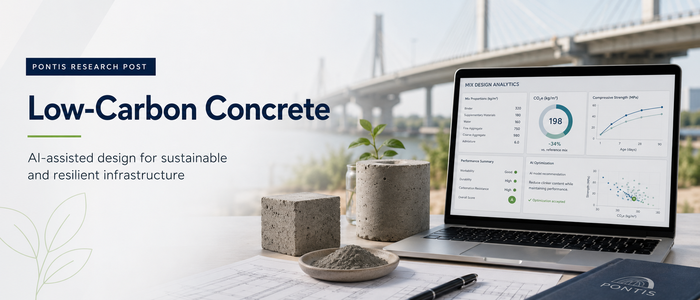
Low-Carbon Concrete: AI-Assisted Mix Design for Sustainable Infrastructure
Why this topic matters
Concrete will remain essential for bridges, buildings, tunnels, foundations, and transport infrastructure. The challenge is not to avoid concrete, but to use it more intelligently. Low-carbon concrete aims to reduce embodied emissions while keeping the mechanical performance, durability, and constructability that civil infrastructure requires.
This is where data-driven design becomes useful. Instead of relying only on repeated trial batches, engineers can use previous test results, material properties, curing data, and performance targets to guide concrete mix design more efficiently.
What low-carbon concrete means
Low-carbon concrete is not one fixed material. It is a design approach that combines several strategies: lower clinker content, supplementary cementitious materials, recycled aggregates where suitable, optimized water-binder ratio, durability-based design, and better quality control during production and curing.
Common strategies
| Strategy | Engineering purpose | Typical benefit |
| Supplementary cementitious materials | Partly replace clinker-rich cement | Lower embodied carbon and improved durability in many exposure conditions |
| Optimized aggregate grading | Improve particle packing and reduce paste demand | Better workability and lower cement demand |
| Performance-based mix design | Design for strength, durability, and service life together | More reliable long-term infrastructure performance |
| AI-assisted optimization | Compare many mix options before laboratory verification | Faster screening and more efficient material use |
AI-assisted mix design
 |
Machine learning models can support mix design by connecting material inputs with expected performance. The model does not replace engineering judgment, but it can help identify promising combinations before full laboratory verification. Inputs may include cement type, supplementary materials, aggregate characteristics, water-binder ratio, admixtures, curing conditions, and measured performance from previous mixes. The useful output is not simply one “best” mix. It is a clearer view of trade-offs: strength versus carbon footprint, workability versus durability, cost versus performance, and early-age strength versus long-term behavior. |
Design inputs and outputs
| Input data | Model prediction | Engineering decision |
| Binder composition and SCM percentage | Compressive strength, strength gain, and CO2 estimate | Select balanced cement replacement level |
| Aggregate grading and recycled content | Workability, packing efficiency, and durability indicators | Avoid overuse of paste and improve material efficiency |
| Curing time and exposure class | Long-term performance trend | Check whether the mix is suitable for the intended environment |
Benefits for civil engineering practice
The real value of AI-assisted low-carbon concrete is practical: faster screening, fewer unsuccessful trial mixes, clearer performance targets, and better documentation of why a mix was selected. For infrastructure projects, this can support more transparent decisions between environmental targets and structural requirements.
- Reduced embodied carbon through more efficient binder design.
- Improved material use by comparing many feasible alternatives early.
- Better durability planning when performance indicators are considered from the beginning.
- More consistent communication between designers, laboratories, contractors, and owners.
Performance and sustainability must be checked together
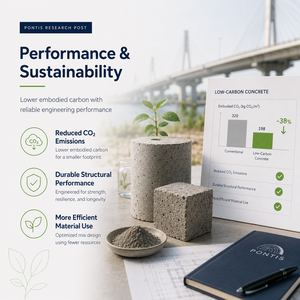
| Lower carbon content is only useful if the concrete still performs well in the structure. A mix that saves cement but reduces durability may create higher repair demand later. For this reason, low-carbon concrete should be evaluated through both environmental and engineering indicators.
The best solutions are usually balanced: sufficient strength, reliable workability, durability appropriate for the exposure class, and a lower carbon footprint over the expected service life. |
 |
Looking ahead
AI will not remove the need for testing, standards, or engineering responsibility. Its role is to make the design process more informed. When used carefully, it can help engineers reduce unnecessary material use, compare alternatives more clearly, and develop concrete mixes that are both sustainable and reliable.
For research groups and design teams, the next step is to connect material databases, laboratory results, structural performance requirements, and life-cycle assessment into one practical workflow. That is where low-carbon concrete becomes more than a material topic: it becomes part of intelligent infrastructure design.