

Seismic Retrofitting of Existing Structures
Strengthening existing bridges and buildings for safer, longer-lasting infrastructure
Many cities depend on bridges, buildings, hospitals, schools, and transport corridors that were designed before today’s seismic performance expectations. Replacing these assets is often unrealistic, expensive, and environmentally demanding. Seismic retrofitting offers a practical alternative: improve the behavior of the existing structure so that it can better protect people, remain usable after an earthquake, and serve the community for longer.
A good retrofit project does not begin with adding steel or concrete. It begins with understanding the structure: its age, geometry, material condition, foundation behavior, previous damage, and expected earthquake demand. The best solutions are usually targeted, evidence-based, and compatible with the existing structural system.
| Core idea
Seismic retrofit is not only repair. It is a performance upgrade that reduces risk, extends service life, and supports more resilient communities. |
Why seismic retrofitting matters
Earthquakes expose weaknesses that may remain hidden during normal service. Poor detailing, insufficient ductility, soft stories, weak connections, inadequate confinement, and aging materials can all lead to serious damage. Retrofitting helps reduce these vulnerabilities before an earthquake occurs.
Common retrofit objectives
| Objective | Engineering purpose | Typical outcome |
| Increase strength | Improve resistance to lateral forces | Lower probability of local or global failure |
| Improve ductility | Allow controlled deformation without brittle collapse | More stable earthquake response |
| Control displacement | Reduce drift and relative movement | Less damage to structural and non-structural elements |
| Protect critical functions | Keep strategic buildings and routes usable | Faster recovery after seismic events |
From diagnosis to intervention
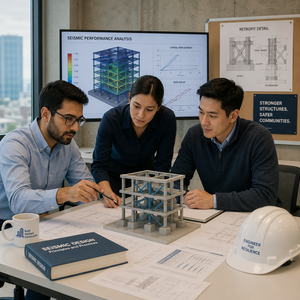 |
A reliable retrofit strategy is developed step by step:
• inspection and document review • identification of critical weaknesses • numerical analysis of seismic demand • comparison of retrofit alternatives • detailing that respects constructability and existing conditions |
Retrofit techniques and where they fit
| Technique | Main role | Typical use | Design attention |
| Steel bracing | Strength and stiffness | Frames and industrial buildings | Connections and force transfer |
| FRP wrapping | Confinement and ductility | RC columns and joints | Surface preparation and anchorage |
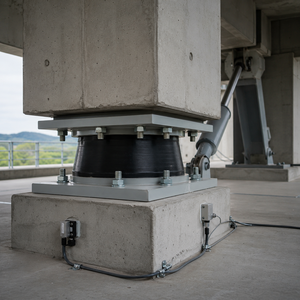
| Dampers | Energy dissipation | Buildings and bridges | Device placement and maintenance |
| Base isolation | Demand reduction | Strategic structures | Displacement capacity and detailing |
A practical example: isolating and dissipating seismic demand
 |
Modern retrofit design increasingly combines traditional engineering judgment with digital analysis. Engineers can compare alternatives, estimate displacements, check member forces, and test whether a proposed intervention improves the overall response rather than only strengthening one local detail.
The most effective solutions are usually those that are simple to inspect, feasible to build, and compatible with future maintenance. |
Key takeawaysSeismic retrofit reduces risk, not only structural weakness. The right intervention depends on the existing structure, seismic demand, foundation behavior, and target performance. Sustainable retrofit can avoid unnecessary demolition while improving safety and extending service life. Digital models, monitoring data, and engineering judgment should work together to support clear decisions. |
|