
Metamaterials: Redefining the Future of Structural Engineering
For decades, engineers have improved structures by developing stronger steel, higher-performance concrete, and more efficient design methodologies. Today, a new class of engineered materials—metamaterials—is opening possibilities that were once considered impossible.
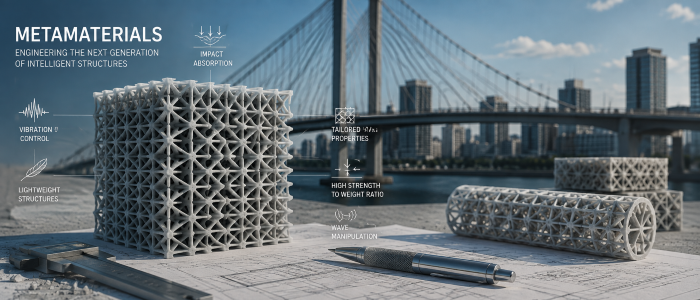
Unlike conventional materials, metamaterials derive their unique mechanical behavior primarily from their carefully designed internal geometry rather than their chemical composition. By tailoring microscopic or mesoscopic architectures, engineers can create materials with extraordinary properties that are unattainable in nature.
This emerging field is attracting growing attention in civil, aerospace, and mechanical engineering, with researchers exploring applications ranging from earthquake-resistant buildings to adaptive bridges and vibration-isolating infrastructure.
What Are Mechanical Metamaterials?
Mechanical metamaterials are architected materials designed to achieve exceptional structural performance through their internal configuration.
Examples include materials that can:
- Absorb extreme impact energy
- Control vibration and wave propagation
- Exhibit programmable stiffness
- Reduce structural weight while maintaining strength
- Recover their original shape after deformation
- Redirect stress away from critical regions
These capabilities are transforming how engineers think about structural resilience and performance.
Why Are They Important?
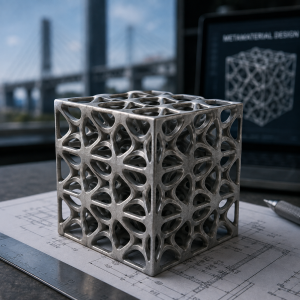
Traditional structural materials are generally optimized for strength or stiffness. Metamaterials introduce an entirely new design philosophy where geometry itself becomes a structural parameter.
This enables engineers to create lighter, smarter, and more adaptive structural components without relying solely on new material chemistry.
The rapid advancement of additive manufacturing (3D printing) has accelerated metamaterial research by enabling the fabrication of complex lattice geometries that were previously impossible to manufacture.
Potential Applications in Civil Engineering
Researchers are investigating metamaterials for numerous infrastructure applications, including:
- Seismic isolation systems
- Bridge bearings with adaptive stiffness
- Protective barriers for blast resistance
- Lightweight bridge decks
- Energy-absorbing structural connections
- Vibration mitigation in tall buildings
- Railway vibration control
- Smart façade systems
- Impact-resistant tunnel linings
- Offshore and marine structures
Many of these concepts remain under active research, but several prototypes have already demonstrated remarkable performance in laboratory testing.
Metamaterials and Earthquake Engineering
One of the most exciting research areas involves seismic metamaterials.
Instead of resisting earthquake waves after they enter a structure, seismic metamaterials aim to manipulate or attenuate wave propagation before damaging energy reaches critical structural components.
Researchers are studying periodic underground structures capable of scattering, filtering, or redirecting seismic waves, potentially reducing vibration transmitted to buildings and critical infrastructure.
Although still an emerging technology, this concept could fundamentally change seismic protection strategies in the future.
Integration with Artificial Intelligence
The design of metamaterials often involves millions of possible geometric configurations.
Artificial Intelligence is increasingly being used to:
- Optimize lattice architectures
- Discover novel unit-cell geometries
- Predict mechanical behavior
- Accelerate topology optimization
- Reduce computational costs
- Enable inverse material design
The combination of AI, computational mechanics, and advanced manufacturing is dramatically accelerating innovation in this field.
Current Challenges
Despite their enormous potential, several challenges remain before widespread implementation:
- Large-scale manufacturing
- Long-term durability
- Cost-effective production
- Standardized design methodologies
- Building code integration
- Experimental validation at infrastructure scale
- Lifecycle assessment and maintenance
Addressing these challenges will require close collaboration between researchers, industry, and standards organizations.
Looking Ahead
Metamaterials represent one of the most exciting frontiers in structural engineering. As computational design, AI-driven optimization, and advanced manufacturing continue to evolve, architected materials are expected to play a significant role in creating infrastructure that is lighter, safer, more resilient, and more sustainable.
The future of structural engineering may not rely solely on stronger materials—but on smarter materials designed from the inside out.
PontisRG Insight
At Pontis Research Group, we believe metamaterials have the potential to reshape the future of civil infrastructure. By combining computational mechanics, artificial intelligence, structural optimization, and advanced manufacturing, engineers can move beyond traditional material limitations and develop the next generation of adaptive and resilient structural systems.
Key Takeaways
- Geometry can be as important as material composition.
- Mechanical metamaterials enable unprecedented structural performance.
- Seismic metamaterials may revolutionize earthquake protection.
- AI is accelerating the discovery and optimization of new metamaterial designs.
- Advanced manufacturing is making complex architected materials increasingly practical.