
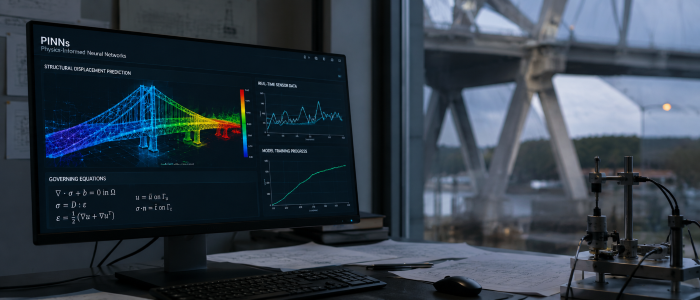
Physics-Informed Neural Networks (PINNs)
Physics-Informed Neural Networks: The Future of Structural Analysis
Artificial Intelligence is rapidly reshaping structural engineering, but one of the biggest challenges remains ensuring that AI models produce physically meaningful and reliable predictions. Traditional neural networks often require enormous datasets and may generate results that violate fundamental engineering principles.
Physics-Informed Neural Networks (PINNs) address this challenge by embedding governing physical laws—such as equilibrium equations, compatibility conditions, constitutive relationships, and boundary conditions—directly into the learning process. Rather than learning solely from experimental or simulated data, PINNs learn from both data and the underlying physics governing structural behavior.
As a result, they require significantly fewer training samples while delivering more robust and interpretable predictions.
Why Are PINNs Important?
Modern infrastructure generates massive amounts of monitoring data through sensors, drones, and digital inspection systems. However, collecting sufficient labeled data for machine learning remains difficult and expensive.
PINNs bridge this gap by integrating engineering mechanics with deep learning, allowing engineers to solve inverse problems, estimate unknown parameters, and predict structural responses with greater confidence.
This approach is becoming particularly valuable for complex civil engineering problems where traditional finite element simulations are computationally intensive.
Key Applications
Recent research demonstrates the growing use of PINNs in:
- Structural Health Monitoring (SHM)
- Damage Detection and Localization
- Crack Identification
- Earthquake Engineering
- Nonlinear Structural Analysis
- Structural Dynamics
- Digital Twin Development
- Bridge Monitoring
- Tunnel and Underground Infrastructure
- Inverse Identification of Material Properties

Advantages Over Conventional Machine Learning
| Conventional AI | Physics-Informed Neural Networks |
|---|---|
| Requires large datasets | Works with limited data |
| Purely data-driven | Combines physics and data |
| May violate engineering laws | Satisfies governing equations |
| Limited extrapolation capability | Better generalization |
| Often behaves as a black box | More interpretable predictions |
The Connection with Digital Twins
Digital Twins are becoming increasingly important for modern infrastructure management. PINNs enhance Digital Twins by continuously updating structural models using real-time sensor measurements while ensuring that predictions remain consistent with the laws of structural mechanics.
This combination enables infrastructure owners to detect damage earlier, optimize maintenance schedules, and extend the service life of critical assets.
Current Challenges
Although PINNs show tremendous promise, several challenges remain:
- High computational cost for large-scale 3D structures
- Difficult optimization of complex neural networks
- Efficient treatment of nonlinear material behavior
- Integration with commercial finite element software
- Real-time implementation for large infrastructure systems
Researchers worldwide are actively developing hybrid frameworks that combine finite element methods, PINNs, and high-performance computing to overcome these limitations.
Looking Ahead
Physics-Informed Neural Networks are expected to become a key technology for the next generation of intelligent structural engineering systems. By merging engineering mechanics, computational science, and artificial intelligence, PINNs are paving the way for more reliable digital twins, smarter infrastructure monitoring, and faster engineering simulations.
As computational capabilities continue to advance, PINNs may fundamentally change how engineers design, assess, and maintain civil infrastructure.
PontisRG Insight
At Pontis Research Group, we believe that the future of structural engineering lies in the integration of physics-based computational methods with artificial intelligence. Technologies such as Physics-Informed Neural Networks have the potential to significantly improve structural assessment, digital twin development, and infrastructure resilience while preserving the engineering principles that ensure safety and reliability.