
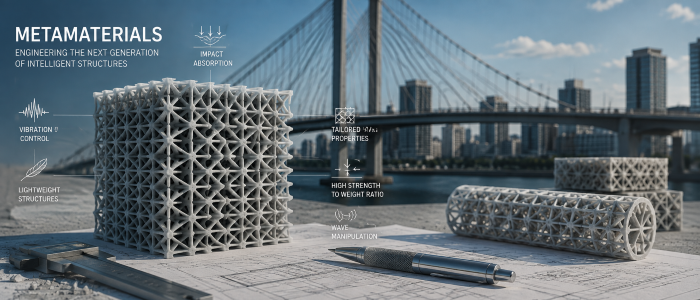
For decades, engineers have improved structures by developing stronger steel, higher-performance concrete, and more efficient design methodologies. Today, a new class of engineered materials—metamaterials—is opening possibilities that were once considered impossible. Unlike conventional materials, metamaterials derive their unique mechanical behavior primarily from their carefully designed internal geometry rather than their chemical composition. By tailoring microscopic […]

Physics-Informed Neural Networks: The Future of Structural Analysis Artificial Intelligence is rapidly reshaping structural engineering, but one of the biggest challenges remains ensuring that AI models produce physically meaningful and reliable predictions. Traditional neural networks often require enormous datasets and may generate results that violate fundamental engineering principles. Physics-Informed Neural Networks (PINNs) address this challenge […]
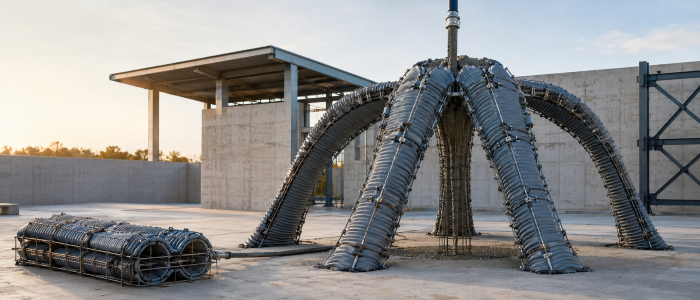
Researchers have introduced an innovative self-deploying formwork system that could significantly reduce the time, labor, and material required to construct reinforced concrete structures. The technology uses interconnected multistable polymer tubes that can be transported in a compact configuration and then automatically expand into a predefined structural form as concrete is pumped into them. Flexible steel […]

The Journal of Civil Engineering Materials and Applications (JCEMA), in collaboration with Pontis Research Group, is pleased to announce an upcoming Special Issue on Lightweight Aggregate Concrete and Geotechnical Applications. This special issue aims to bring together high-quality research that advances the understanding and application of lightweight aggregate (LWA) materials in structural, geotechnical, and infrastructure […]
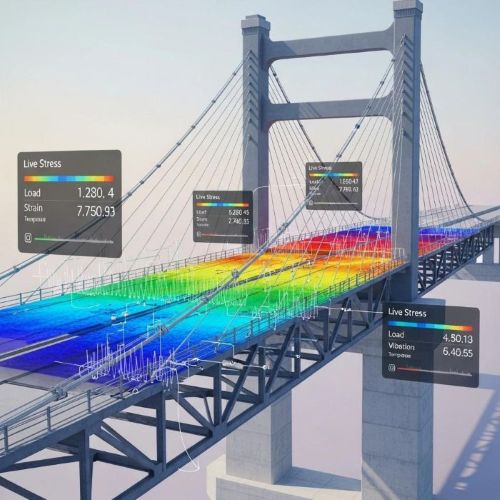
AI-Driven Structural Optimization: A New Era in Sustainable Engineering Artificial Intelligence (AI) is rapidly transforming structural engineering from a discipline driven primarily by experience into one powered by intelligent data analysis and optimization. Recent research demonstrates that AI can significantly improve structural design, optimize material usage, and enhance the long-term safety of buildings and bridges. […]

Artificial Intelligence is expected to become a core component of next-generation structural engineering. By combining advanced sensing technologies with intelligent algorithms, engineers can shift from reactive maintenance toward predictive infrastructure management.

Discover how smart transportation infrastructure, AI, Digital Twins, and structural health monitoring are transforming bridges, roads, railways, and other critical transportation networks.

Explore how environmental intelligence is transforming structural engineering through climate adaptation, sustainable design, nature-based solutions, and life-cycle thinking.